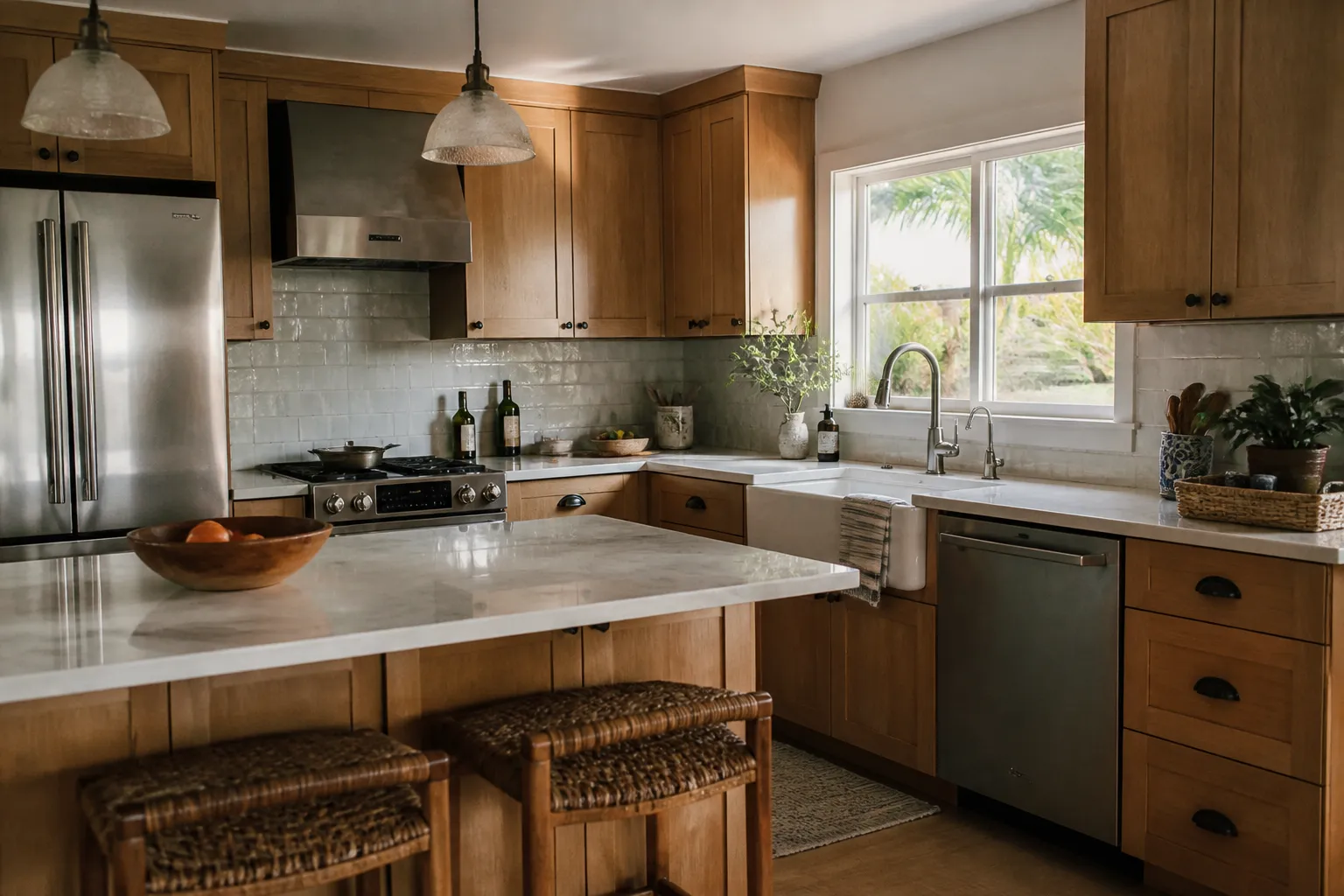
Apollo Beach Custom Cabinets designs, builds and installs custom cabinets for homeowners across Apollo Beach, FL. Almost every garage follows the same path. A shelf unit goes in, then a second one, then some plastic bins, then a pegboard, and within two years the car is parked in the driveway. The problem is not the amount of storage — it is that it arrived one piece at a time with no plan.
Planning the whole wall at once takes an afternoon and changes the outcome entirely.
Start by deciding what the garage is for
Be specific. A garage that must fit two cars has roughly 24 inches of depth available along the back wall and not much more. A garage where one bay is a workshop can use 30 inches on one side. Writing this down first prevents the classic outcome where cabinets are deep enough that the car no longer fits.
Zone the wall
A workable layout breaks the main wall into four zones:
1. Tall closed storage
At one end, an 84 or 90 inch tall cabinet for long items — rakes, a ladder, a shop vac, pool equipment. This is what keeps awkward items off the floor.
2. Workbench with drawers below
Bench surface at 36 inches. Below it, a drawer bank rather than shelves. Hand tools in drawers stay sorted; hand tools in bins on shelves do not.
3. Upper cabinets
Above the bench and along the rest of the run, with the bottom at about 54 inches so the bench stays usable. Closed doors keep dust off, and Florida garages collect a lot of it.
4. Open hooks or a rail
At the end nearest the door, for the things that come and go daily — beach chairs, a leaf blower, a bike. If those have to go behind a door, they end up on the floor instead.
Wall-hung beats floor-standing
Getting cabinets off the floor is the single best decision in a garage. You can sweep and hose underneath, water that comes under the door during a summer storm does not reach anything, and the floor stays clear.
Mount into studs with a full-length hanging rail, not drywall anchors. A loaded garage cabinet run is heavy.
Materials for a Florida garage
An uninsulated Apollo Beach garage sits at high humidity most of the year and gets genuinely hot in summer. That rules out a few things:
- Particleboard with thermofoil doors — the film delaminates in heat and the core swells in humidity. The most common garage cabinet failure.
- Bare MDF — absorbs ambient moisture even without a leak.
- Powder-coated steel — fine, but any chip near the coast starts rusting.
What holds up: plywood boxes with high-pressure laminate or a catalysed finish, and full-extension ball-bearing steel slides. Our garage cabinets are specified that way rather than using kitchen-grade construction.
What not to store in a Florida garage
Paint and adhesives separate and go off. Batteries and anything with a lithium cell degrade. Aerosols and propane become a genuine hazard above about 120 degrees. Paper goods, photographs and fabric attract mildew and pests.
A cabinet does not change any of that — it only hides it. Those items belong inside the conditioned house.
The habit that keeps it organised
Label the zones, not the bins. Bins get moved and re-purposed; a labelled shelf edge or drawer front stays where it is. The other thing that works is leaving a deliberate empty shelf — a garage with no slack fills the floor the moment anything new arrives.
If you are also finishing the floor or conditioning the space
Do the floor before the cabinets go in, and decide about a mini-split before ordering. A conditioned garage opens up cheaper cabinet materials and makes the space usable year-round, which changes what is worth building.
The same planning applies to overflow storage in custom closets and pantry cabinets inside the house, which is where the climate-sensitive items should end up.
Frequently asked questions
How deep should garage cabinets be?
Upper cabinets 12 to 16 inches; base or bench cabinets 24 inches. Anything deeper along a wall a car parks against is a problem.
Do I need doors?
In a humid, dusty Florida garage, yes for anything you care about. Open shelving is fine for items in sealed bins.
Can garage cabinets hold heavy tools?
Properly mounted into studs, several hundred pounds per run. Use heavy-duty slides for drawers that will hold power tools.
Should the workbench be fixed or on casters?
Fixed is more stable for real work. A rolling cart in addition is useful and gets used more than expected.
Plan the whole wall once
Send us the garage dimensions and a list of what needs a home, and we will lay out the full wall. Call (813) 922-3358.